Local newspaper archives online: checklist for local history
You've typed a grandparent's name into three different archive search boxes, and every result returns either nothing or a wall of unrelated matches from across the country. The frustration feels personal — as if the history itself has gone missing.
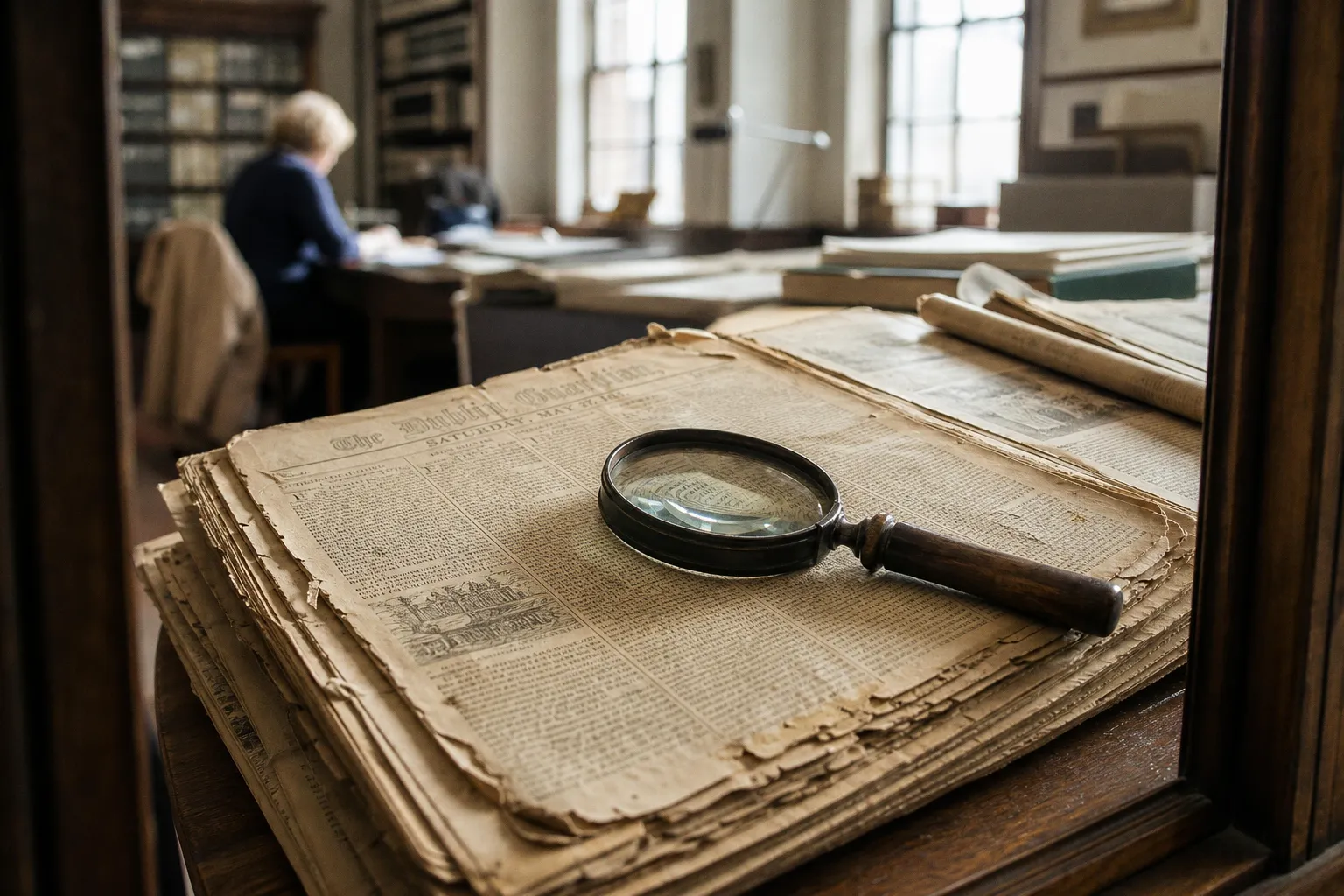
Get oriented: the major repositories at a glance
Before you spend a dollar or an afternoon, it helps to know which archive fits which question. No single site covers everything, and the smartest strategy is layering free and paid resources instead of committing to just one. Free portals handle broad sweeps and confirmation, while paid databases and library subscriptions tend to unlock deeper, more recent, or more regional runs.
Here is how the heavy hitters stack up on cost and coverage:
| Repository | What's inside | Free or paid | Best for |
|---|---|---|---|
| Chronicling America (Library of Congress + NEH) | 22M+ digitized pages of U.S. newspapers, coverage runs through 1963 | Free | Pre-1963 U.S. research, anyone on a budget |
| British Newspaper Archive (British Library + Findmypast) | 100M+ digitized pages as of February 2026, growing | Paid, with library trial access | UK and colonial press, Irish and Welsh titles |
| Newspapers.com (Ancestry) | 1B+ pages from 30,000 papers back to the 17th century | Paid (publishers Extra tier extends into recent years, often up to 2018) | Largest U.S. collection, easiest browsing |
| OldNews.com (MyHeritage, launched March 2024) | 300M+ pages in 12 languages | Paid, with MyHeritage subscription bundles | International genealogy, non-English press |
| Community History Archives (Advantage Archives) | 1,100+ free local portals, 125M+ images, library-partnered | Free | Small-town U.S. coverage you won't find in the big aggregators |
Notice how the bigger isn't always better for your purposes. Chronicling America is genuinely the most cost-effective starting point for U.S. research through the mid-20th century, and its companion U.S. Newspaper Directory tells you what else exists even when it isn't digitized — we'll come back to that.
If you're outside the U.S., or you're tracing a family line through immigration, you'll likely end up bouncing between at least two of the paid services. Most genealogy researchers eventually subscribe to one (typically the one their library already offers trial access to) and then loop in OldNews.com or BNA as needed for specific date ranges.
Zero results isn't a verdict on your ancestor — it's a verdict on your search string. Change the string before you change your theory.
Work with the OCR, not against it
Here's the single most important thing to internalize about historical local newspapers online: nearly every search runs through optical character recognition. That tech has gotten dramatically better, but it still stumbles on fuzzy microfilm, smudged ink, and tight column layouts. So when you type a name and get nothing back, the page you're looking for might literally be in front of you — the engine just couldn't read the word.
A few adjustments rescue most "failed" searches:
- Search by surname first, then narrow. Nineteenth-century papers routinely printed only a surname, especially in legal notices, court reports, and church news. Searching "Whitfield" first opens more doors than searching "Eleanor Whitfield."
- Use wildcards for missing letters. If you're unsure of a spelling (Whitfield or Whitfeld?), the truncation symbol varies by platform — an asterisk or a question mark — but the principle is the same: cover the variants in one go.
- Try alternative spellings deliberately. Names were spelled phonetically and the spellings drifted between censuses. Pull a few variations from census records, then run each one.
- Quote exact phrases. If you're looking for a specific marriage announcement or obituary phrase, the search engine will respect quotes and skip pages where the words appear in scattered, unrelated places.
- Drop the first name when the date range is broad. If you're searching 1860 through 1890, the surname alone is usually the right move.
One more habit that helps: when you do find the right article, screenshot or save it immediately, because OCR transcripts can drift between page versions and subtle differences in the source scan will surface.
When the paper isn't online: check the directories
A big misconception when searching local newspaper archives online is that anything not found on a paid site simply doesn't exist in print. The opposite is closer to true. Vast stretches of small-town press have never been digitized, especially issues from the mid-20th century forward, and many smaller titles survive only on microfilm in a county library somewhere.
This is where directories come in, and they're quietly the most underused tool in the whole checklist. Chronicling America's U.S. Newspaper Directory, for instance, lists more than 157,000 titles published since 1690 — including thousands of papers that haven't been scanned at all. The directory tells you which library holds the run, what format it's in (microfilm, original print, bound volumes), and roughly what date range the holding covers.
That record is gold for two reasons. First, it confirms a paper existed, so a zero-result search online isn't a dead end — the holding just lives in a reading room. Second, it gives you a specific place to call or email. Most state libraries and university libraries will pull microfilm for a flat fee or, in many cases, offer free digital scans if you write to the reference desk with a precise citation request.
For U.K. research, the equivalent is the British Library's newspaper catalog and Findmypast's holdings metadata, which together tell you which issues BNA plans to add and which would require a physical visit. Library access through the British Library's reading rooms or a partner university library is one of the most cost-effective ways to view pre-digitized runs.
So the actual research move is: directory first, repository second. Confirm the paper exists and where the holding lives. Then decide whether to wait for digitization, request a scan, or make a research trip.
Don't just search your local paper
A subtle trap when working through digital local archives is treating "local" too literally. Town A's weekly paper and Town B's weekly paper in a neighboring county often reprinted each other — sometimes verbatim, sometimes with a one-paragraph rewrite. Wire services like the Associated Press circulated stories far beyond the originating paper, so a regional event might show up in a paper from the opposite corner of the state, or even from a paper three states over.
This is particularly true for:
- Crime reports and court cases. These traveled well in the 19th century and showed up in dailies a hundred miles away.
- Wedding and funeral announcements. Especially for prominent families, a marriage in Iowa could appear in a New York paper and vice versa.
- Disasters and unusual events. Tornadoes, mine collapses, shipwrecks — anything dramatic was widely reprinted.
- Religious and revival news. Circuit preachers and revival meetings routinely made regional press.
So the workflow adjustment is simple: when the immediate-town paper comes up empty, expand your date range to the surrounding region. Add neighboring counties, then the state, then the broader region. If you're using a service like Newspapers.com or BNA, that usually means toggling your location filter from a single town to a county or state.
For immigrants and diaspora research, the same logic applies across languages. OldNews.com's 12-language coverage is particularly useful here: a Czech or Italian surname you couldn't find in English-language papers may show up in immigrant-community weeklies that were never aggregated elsewhere.
Keep a real research log
This is the unsexy step that experienced researchers treat as gospel and beginners skip — then regret. A research log does not need to be elaborate. A spreadsheet with five columns is plenty: date searched, repository, search string used, results (count or summary), and next step. Some researchers add a sixth column for "questions raised" — anomalies that didn't fit the existing theory.
Why bother? Because historical local newspaper searches generate dozens of false starts. Without notes, you'll re-run the same failed search three weeks later, sometimes on a different platform, and forget what you already learned. With notes, you can hand your log to a relative, a librarian, or a fellow researcher and have them pick up where you left off without an hour of orientation.
A few specific habits that pay off:
- Record the exact search string, not just "Whitfield obituary." Quotes, wildcards, and date filters all matter later.
- Note the date range you searched, not just the year. "1870s" is weaker than "1873–1877."
- Mark what was not there. "No result for Whitfield, Gloucester County, 1850–1860" is genuinely useful negative evidence.
- Track which repository you tried. The same string behaves differently across platforms, and you don't want to assume OldNews.com returned the same set as BNA.
If you're a more casual researcher — say, looking into your hometown's history once, not building a family tree — even a one-page document with the searches you ran and what you found is enough. The point is that you can reproduce your work later, or hand it off.
Match the workflow to the type of researcher
Different readers need different cost-and-time tradeoffs, so here's how to think about it:
- Casual curiosity, single event (a house fire, a 1950s parade, a notable resident): start with Chronicling America and Community History Archives. Both are free, and one of them usually surfaces a usable page within ten minutes.
- U.S. genealogy through the late 19th century: layer Chronicling America (free, pre-1963) with Newspapers.com via institutional access (many public libraries offer free entry to subscribing cardholders).
- U.K. or colonial genealogy: the British Newspaper Archive is the primary tool; a Findmypast or British Library reader's ticket unlocks the heaviest coverage.
- Multi-country or non-English migration history: OldNews.com's multilingual reach is hard to replace, especially for Eastern and Southern European lines.
- Local history projects requiring paper runs not yet digitized: the U.S. Newspaper Directory is your real starting point. Identify the holding, contact the library, request scans or arrange a visit.
The cleanest, most cost-effective baseline for almost anyone is this: confirm the paper exists in a directory, search the free layer first, then add the paid database that best matches your region and time frame — preferably through a library rather than a direct subscription, because institutional access typically costs less per month and bundles several services.
Working through local newspaper archives online rewards patience far more than it rewards raw searching speed. The historical record is genuinely there for most well-documented families and events; the trick is using the right doorway, in the right order, with a search string the OCR can actually read. Run the checklist, keep the log, and treat every zero result as a hint about where to look next rather than a verdict.