Evaluate Historical Newspaper Databases Before Buying
A historical newspaper database can look complete while failing at the two tasks that matter: locating the right issue and rendering the page at research-grade quality. The failure is usually not visible in the sales interface.
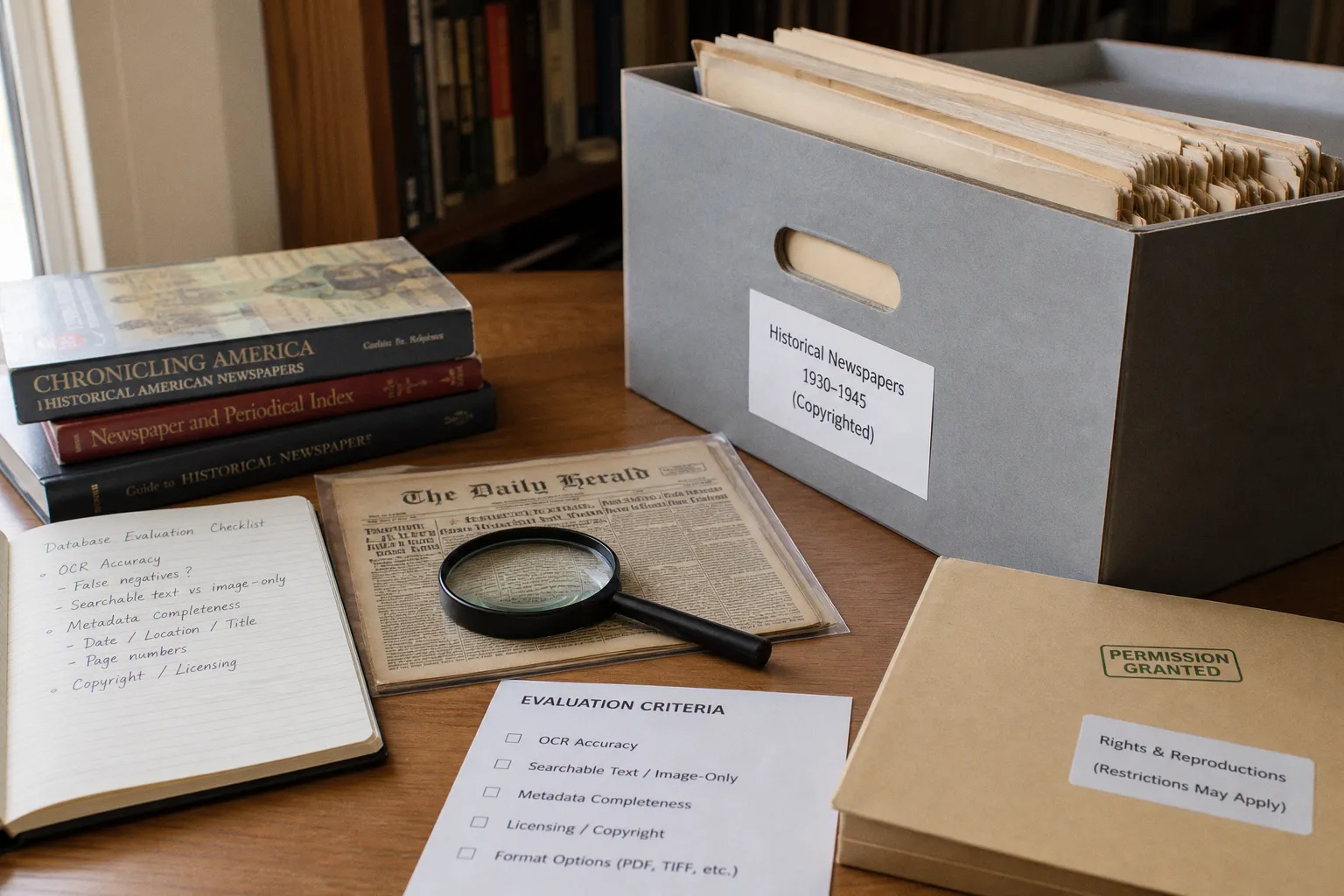
For anyone asking how to check evaluate historical newspaper databases before buying, the answer is not a feature list. It is a controlled inspection of content coverage, OCR behavior, scan resolution, metadata structure, and access rights. A platform with millions of pages can still be weak if its OCR produces false negatives, if its holdings are geographically uneven, or if post-1929 material is restricted by copyright.
Distinguishing Between Image-Only Scans and Searchable OCR Text
Historical newspaper platforms usually expose content in one of two base formats. The first is image-only: scanned page images, often derived from bound volumes, loose issues, or microfilm. The second is searchable text: machine-readable text generated through OCR, or Optical Character Recognition. A mature archival platform normally combines both.
The distinction is not cosmetic. It determines whether the database can support keyword discovery or only visual browsing.
An image-only archive may be perfectly useful for reading a known issue. It can preserve the layout, advertisements, masthead, column order, and page context. For local history and newspaper design work, that page fidelity is often essential. But image-only access is weak for discovery. If the date is unknown, or if a researcher is tracing a person, ship name, business, court case, or street address across decades, page-by-page browsing becomes slow and lossy.
Searchable OCR text solves part of that problem. It allows names, phrases, dates, and topics to be queried across large holdings. It also enables snippet previews, relevance sorting, and sometimes article segmentation. But OCR is only as good as the source image and recognition pipeline. Nineteenth- and early twentieth-century newspapers are hostile input: dense columns, degraded ink, broken type, irregular spacing, ornate fonts, bleed-through, folded pages, skewed microfilm, and damaged edges.
The minimum acceptable database for serious work is therefore hybrid: scanned page images plus searchable OCR text, with a visible path from search result to page image.
| Archive format | Strength | Failure mode | Suitable use |
|---|---|---|---|
| Image-only scans | Preserves full page layout and original visual evidence | No reliable keyword discovery | Known-date browsing, citation verification, visual layout research |
| Searchable OCR text only | Fast keyword retrieval | Loss of page context; transcription errors may be hidden | Lightweight reference use, broad discovery |
| Hybrid page image + OCR | Search and source verification in one workflow | Quality depends on OCR and scan resolution | Genealogy, legal history, local press research, academic citation |
A buyer should test whether the OCR text is exposed only as search infrastructure or also available for inspection. If the text layer is invisible, error diagnosis becomes difficult. If a name is absent from results, the user cannot tell whether the issue is missing, the OCR failed, or the query engine discarded the term.
For e-paper and PDF workflows, the same principle applies. A historical PDF replica is not automatically searchable. Some PDFs are only page images wrapped in a PDF container. Others include an embedded OCR text layer. The difference is measurable: selectable text, copy behavior, search hit highlighting, and exported text quality should all be tested before procurement.
Page images prove what was printed. OCR only improves the probability of finding it.
The Critical Role of OCR Accuracy in Keyword Discovery
OCR accuracy is the single highest-risk technical variable in historical newspaper databases. A platform can advertise full-text search while still missing a large share of relevant articles. This is not a contradiction. It is a predictable result of imperfect recognition.
High-quality OCR digitization projects often target accuracy above 95%. That figure is useful as a benchmark, but it requires qualification. Character-level accuracy above 95% does not guarantee phrase-level or name-level reliability. A single misread character can break a surname query. "Harrington" read as "Harnington," "Barrington," or "Harrmgton" may disappear from exact search. In older papers, type damage and column compression make this common.
False negatives are the main operational hazard. A false positive wastes time. A false negative silently removes evidence from the research path.
A proper evaluation should include known-item testing. This is more reliable than searching for broad terms and judging result volume. The procedure is simple and should be repeated across titles, decades, and page conditions:
1. Select several known articles from the target archive. Use citations from existing bibliographies, library catalog notes, clipping files, or microfilm references.
2. Search by exact title phrase if available. Then search by distinctive proper nouns, street names, business names, and uncommon spellings.
3. Compare search results against manual page browsing. If the article is visible on the page but absent from search, the OCR or indexing layer failed.
4. Test degraded pages separately. Include pages with skew, dark margins, broken type, tight columns, or microfilm blur.
5. Record whether search hit highlighting lands on the correct word, the wrong column, or an adjacent page region.
This testing should not be done only on major metropolitan titles. Regional newspapers often have worse source quality and less consistent digitization. Small-town papers may have unusual mastheads, irregular issue numbering, local supplements, or mixed-language columns. These properties degrade both OCR and metadata parsing.
Search behavior must also be inspected. Exact phrase search, Boolean operators, proximity search, wildcard support, stemming, fuzzy matching, and date filters affect real retrieval performance. A database with weaker OCR but strong fuzzy matching may outperform a cleaner archive with a primitive search engine for name discovery. Conversely, aggressive fuzzy search may increase noise when researching common surnames.
The result screen should disclose enough information to triage errors. At minimum, a useful search result includes newspaper title, publication place, date, page number, snippet, and a direct jump to the page image. A result that shows only a fragment of OCR text without edition or page context is weak for archival work.
Verifying Metadata Completeness for Precise Archival Retrieval
Metadata is the retrieval frame around the scanned page. Without it, the archive becomes a pile of images with a search box attached.
The required fields are not elaborate. They are basic: newspaper title, publication date, location, issue or edition where available, page number, and preferably section. For historical archives, title changes and merged papers also need authority control. A newspaper may change name, absorb another title, or publish morning and evening editions. If the platform treats these as unrelated strings, longitudinal research becomes unreliable.
Metadata completeness should be tested at three levels.
First, title-level metadata. The database should show the full run available for each newspaper, including gaps. "Coverage: 1885–1932" is not enough. A serious platform discloses missing years, missing months, or irregular holdings. Continuous date ranges are often marketing shorthand, not archival reality.
Second, issue-level metadata. Each issue should have a date, title, place of publication, and edition designation where relevant. Sunday supplements, extra editions, war extras, and regional inserts should not be collapsed without indication. In newspaper archives, edition identity matters because stories, advertisements, and even page counts can differ.
Third, page-level metadata. Page number, image sequence, and OCR alignment should be inspectable. Page 4 in the printed issue may not be image 4 in the scan sequence if covers, inserts, or damaged sheets were included. Systems that confuse printed page number with image sequence can produce unstable citations.
A buyer should perform metadata spot checks across the platform's claimed strengths. If the vendor emphasizes regional press editions, test small newspapers and border-region titles. If it claims national coverage, test title variants and city editions. If the platform supports historical research, test pre-1929 and post-1929 access separately.
| Metadata field | Why it matters | Defect to detect |
|---|---|---|
| Date | Enables chronological filtering and citation | Wrong day, missing issue, undifferentiated month/year |
| Location | Separates same-name titles and regional editions | City omitted or merged with county/state only |
| Newspaper title | Supports title runs and name changes | Variant titles treated inconsistently |
| Page number | Required for citation and verification | OCR result jumps to page image without stable page data |
| Edition/section | Distinguishes morning, evening, regional, or supplement content | Multiple editions collapsed into one record |
| Holdings gaps | Prevents false assumptions about absence of evidence | "Coverage" range hides missing issues |
A missing metadata field is not a minor inconvenience. It changes what can be proven from the archive.
Metadata also determines export quality. Citation tools, CSV exports, PDF downloads, and saved clippings should preserve date, title, page, and location. If exported files strip this information, the downstream archive becomes brittle. Researchers then depend on filenames, screenshots, or manual notes. That is not acceptable for institutional procurement.
Navigating Copyright Thresholds and Public Domain Access
Access rights are not uniform across historical newspaper databases. In the United States, newspapers published before 1929 are generally in the public domain. Later issues may still be under copyright, and access can be limited by licensing terms, institutional subscriptions, publisher agreements, or platform restrictions.
This matters during evaluation because the most visible holdings may not match the content available under the buyer's license. A demo account may expose sample pages. An institutional subscription may allow search but not download. A public terminal license may differ from remote access. Some archives allow page viewing but restrict PDF export, bulk download, text mining, or redistribution.
The technical evaluation therefore has to include rights behavior, not just content behavior.
A buyer should verify:
- Whether pre-1929 material can be viewed, downloaded, cited, and reused without additional restrictions.
- Whether post-1929 material is searchable but partially hidden, snippet-only, or limited to on-site access.
- Whether page images, OCR text, and PDF replicas have different export permissions.
- Whether saved clippings include enough bibliographic metadata for later verification.
- Whether license terms permit classroom use, library remote access, genealogy society access, or computational analysis.
- Whether account authentication affects access to regional editions or specific publishers.
The platform should make these distinctions visible before purchase. Ambiguous rights language creates operational cost. A library or research office may discover only after implementation that the archive cannot support the intended use case.
Rights are also relevant to digital preservation. If a platform permits viewing but not durable export, it is access infrastructure, not a preservation copy. That may still be adequate for many users. It is not equivalent to acquiring archival-quality PDFs or image files.
Commercial databases can be especially opaque on price and license structure. Quote-based pricing varies by institution size, access model, and collection scope. That variability is normal. What is not acceptable is uncertainty about what the license actually unlocks.
This is where adjacent digital subscription habits can mislead buyers. A newspaper archive is not a standard software-as-a-service subscription with a single account state. The access model is closer to negotiated infrastructure: user type, location, rights holder, date range, and file format all matter. SaaS products typically offer uniform tiers, predictable pricing, and account-level permissions that scale linearly. Newspaper licensing rarely behaves that way. A single platform may bundle content from dozens of rights holders, each with different restrictions by date, geography, and export format. The buyer needs to understand which layers of access the license actually unlocks, not assume that a subscription fee clears all barriers.
Technical Standards for Archival-Quality Digitization
Scan quality determines the upper bound of every downstream function. OCR, zoom behavior, print output, and PDF readability all degrade when the source image is weak.
Archival newspaper scanning commonly falls in the 300–600 DPI range. At 300 DPI, modern type and clean pages may be usable. At 400–600 DPI, small type, dense classifieds, legal notices, stock tables, and degraded print have a better chance of being preserved. Higher resolution is not automatically better if compression is aggressive or if the source microfilm is poor. But below archival norms, text edges soften and OCR failure rates increase.
Resolution should be evaluated with actual page content, not just vendor specifications. A nominal 400 DPI scan can still be weak if created from a low-quality film source. Conversely, a clean 300 DPI scan from an original page may outperform a higher-resolution scan from damaged microfilm. The observable metrics are edge sharpness, column alignment, contrast stability, halftone handling, and legibility under zoom.
Compression artifacts require close inspection. Newspaper pages contain dense black text on aging paper. Lossy compression can create halos around letters and smear punctuation. This is especially damaging for genealogy research, where initials, middle names, and street numbers matter. JPEG artifacts around commas and periods can change interpretation.
Front-end rendering also matters. Even when the stored image is adequate, the web viewer may introduce latency or resampling defects. Page tiles may load slowly. Zoom levels may jump rather than scale smoothly. Text may be over-sharpened at one zoom level and blurred at another. For heavy users, rendering latency is a productivity issue, not a cosmetic flaw.
The following technical observations should be recorded during testing:
1. Effective page resolution. Confirm whether scans sit in the 300–600 DPI archival range, and test legibility of small advertisements, classifieds, and legal notices.
2. Source type. Determine whether images were scanned from original paper, bound volumes, or microfilm. Microfilm-derived pages often show skew, density shifts, and lost margins.
3. OCR alignment. Check whether highlighted search hits correspond to the correct word and column. Misalignment indicates page segmentation or coordinate mapping defects.
4. Viewer performance. Measure page load and zoom response on typical institutional hardware, not only on a fast test machine.
5. PDF export quality. Download representative pages or issues if allowed. Confirm whether the PDF contains selectable text, stable page images, and embedded metadata.
6. Image handling of damaged pages. Inspect torn, stained, folded, or dark pages. These determine worst-case performance.
7. Citation stability. Save a result, return later, and confirm that the page URL or platform identifier still resolves to the same item.
For e-paper and PDF newspaper access, PDF behavior is often the deciding factor. Some archives produce PDFs that are little more than stitched page images with no text layer. Others generate compact, searchable PDFs with embedded metadata, stable pagination, and clean text extraction. The difference is not subtle. A researcher who needs to quote, annotate, or cross-reference will notice immediately.
A final note on scale. Large commercial databases may contain tens of millions of pages. That volume is impressive but not self-validating. Coverage density varies by region, era, and language. A database strong in nineteenth-century New York dailies may have almost nothing for mid-century Southern weeklies. A platform rich in English-language broadsheets may be sparse on immigrant press, African American newspapers, or foreign-language editions. The only way to assess fit is to test against the specific research needs the archive is supposed to serve.
A million pages means nothing if the one you need is unreadable, unsearchable, or locked behind an ambiguous license.
Evaluating a historical newspaper database before buying is not a single checklist exercise. It is a structured trial that tests what the platform actually delivers under realistic research conditions. Image quality, OCR reliability, metadata depth, search behavior, export capacity, and rights clarity all matter. Each one can fail independently. A platform that excels in three and collapses in two is not a safe investment. The buyer's job is to find the weak points before they become operational problems.