Boox Picco: Evaluating the Pocket-Sized E-Reader for Digital Periodicals
Kindle, Kobo and Libby content may be delivered through their respective apps, according to Mashable’s description of Google Play support.
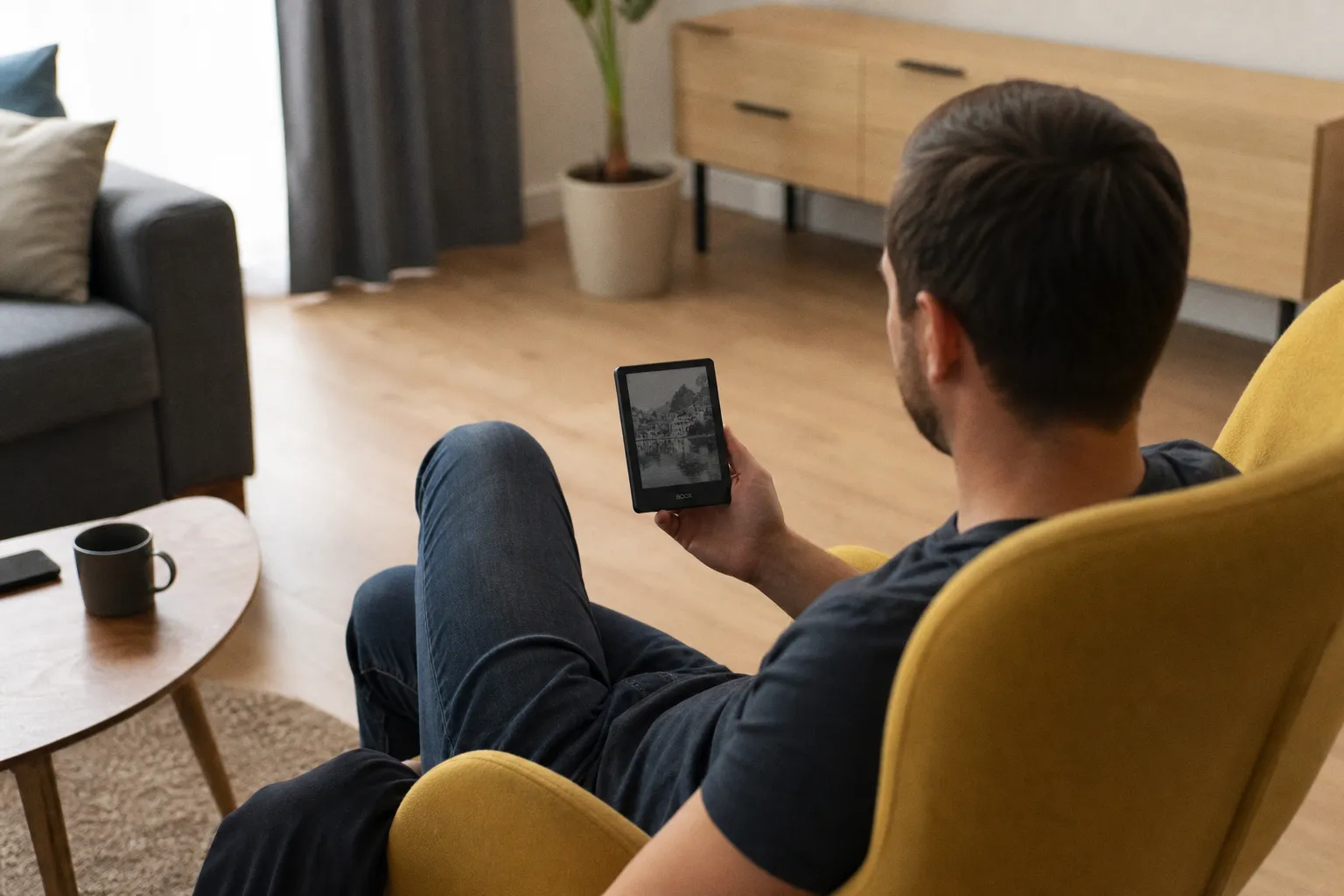
According to Mashable, Boox has introduced the Picco with a 3.97-inch display and planned Google Play Store support, positioning it as the company’s smallest announced e-reader. The relevant specification is not the size alone: access to Kindle, Kobo and Libby through app sync could make the Picco a compact endpoint for existing digital newspaper and book libraries rather than a separate storefront.
Engadget additionally reports that the Picco uses a monochrome e-paper panel, includes a frontlight, and supports microSD storage. For readers who archive periodical PDFs or maintain several reading-app libraries, that combination warrants a more methodical check than the “pocket-sized” form factor suggests.
A 3.97-inch panel changes the document use case
The Picco’s 3.97-inch display is its defining constraint. On a monochrome e-paper reader, this format can be evaluated separately for reflowable app content and fixed-layout documents.
Their usefulness on the Picco will nevertheless depend on each app’s own typography, navigation and download behavior; none of those implementation details has been confirmed in the announcement snippets.
PDF newspapers should be treated as a separate workload. A compact screen does not alter a newspaper PDF’s page geometry. Before choosing the device for press archives, readers should verify practical controls for zooming, panning, page rotation and crop handling in the intended app. The available reports do not specify these functions, rendering latency, refresh modes, or ghosting behavior.
This distinction matters. A device can provide access to an app catalog while remaining a poor fit for full-page edition replicas. App availability is not evidence of comfortable fixed-layout reading.
Play Store support is the operational feature to watch
The stated Google Play Store support is the most consequential part of the Picco announcement for a mixed-library reader. It potentially consolidates Kindle, Kobo and Libby applications on one e-paper device instead of requiring a reader to commit to a single content ecosystem.
That does not confirm that every app will behave identically, or that every subscription and regional edition will be available in every account. It also does not establish whether downloaded publications can be saved to removable storage. The announcement identifies microSD support, but not which files or applications can use it.
For an e-paper newspaper workflow, separate three questions:
1. Can the required reading app be installed through Google Play?
2. Can the publication be downloaded inside that app?
3. Can the downloaded item be managed in the way the reader expects, including any role for microSD storage?
Those are distinct checks. Treating them as one capability is a common source of avoidable purchase errors. Broader developments in digital reading platforms remain relevant context, but the Picco should be assessed from its announced hardware and app-access provisions rather than assumed feature parity; see digital-world and IT industry coverage for adjacent reporting.
Confirm the missing performance data before buying
The disclosed hardware list is concise: 3.97-inch monochrome e-paper display, frontlight, microSD support and intended Google Play Store compatibility. No supported file formats, storage capacity, display resolution, DPI, battery estimate, price, release timing, processor details, frontlight uniformity, or refresh performance are stated in the provided reports.
Those omissions prevent a technical verdict on the Picco as a PDF-newspaper device. They also prevent direct comparison with larger e-readers, where screen area and document scaling are central variables.
The current conclusion is therefore narrow. Boox has announced an unusually small e-reader with a front-lit monochrome e-paper screen, microSD support and a potentially broad app route through Google Play. It may be relevant as a portable reader for app-based libraries. Until handling of fixed-layout PDFs, app performance and storage behavior are documented, it should not be selected specifically as an archive-first newspaper reader.