Hisense's E Ink phone has a full-color LCD you can snap on the back
The Hisense A10 enters the dual-screen E-Ink phone category with a 6.13-inch monochrome main panel and a magnetically attached color LCD that snaps onto the rear chassis.
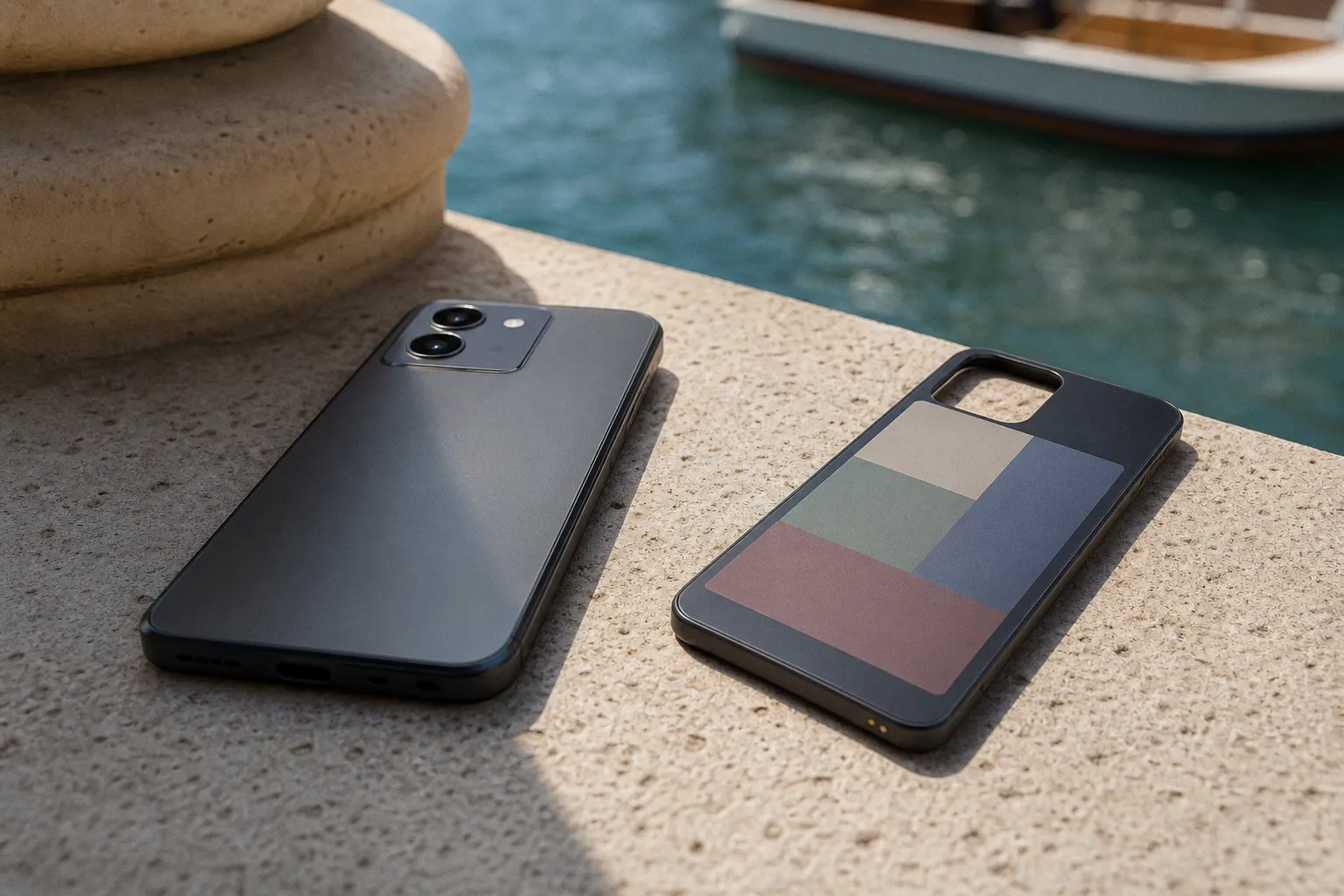
Hardware configuration for text rendering
The A10's primary panel is described as a paper-like 6.13-inch E-Ink touchscreen intended for reading, studying, and note-taking. Exact pixel density has not been disclosed by Hisense in the materials reviewed, which is itself a signal: until confirmed, all rendering-latency and ghosting claims should be treated as preliminary.
For direct comparison, the Bigme HiBreak Dual 2 — currently funding on Kickstarter — specifies its black-and-white E-Ink front display at 824×1648 with 300 PPI and its rear LCD at 720×1280 at 296 DPI. A Kaleido 3 color E-Ink variant reduces the front resolution to 412×994 at 150 PPI. Bigme pairs the panel set with 36 levels of warm and cool frontlight brightness, a metric the A10 announcement does not yet match.
These figures matter for PDF and epaper workflows. At 300 PPI monochrome, small-column newspaper text renders without anti-aliasing artifacts; at 150 PPI color, magazine layouts remain readable but charts and photographs lose fine detail. The A10's unconfirmed pixel density is the single specification that should be verified before committing to an import order.
Software stack and refresh behavior
Hisense is reportedly targeting Android 16 on the A10, with Snapdragon 8 Gen 3 silicon per Good e-Reader's reporting. The pairing implies headroom for aggressive E-Ink refresh algorithms, though no proprietary fast-refresh implementation has been confirmed.
Bigme takes the opposite tack with the HiBreak Dual 2: its Fast-Refresh technology runs on a Dimensity 8300 SoC, paired with either 12GB RAM / 256GB storage or 16GB / 512GB. The device supports a 4,096-level pressure-sensitive stylus, dual-SIM 5G, WiFi, Bluetooth 5.3, and ships with Android 16 plus Google Play pre-installed — a meaningful advantage for readers who depend on specific newspaper or RSS applications outside of sideloading.
Hisense has not stated whether Google Play will ship pre-installed on the A10. For readers relying on subscription apps, regional newspaper clients, or DRM-protected PDF libraries, that distinction is operational, not cosmetic.
Availability, pricing, and verification steps
Early pricing for the Hisense A10 is reported to start around $590, with the understanding that the detachable LCD may be sold separately rather than bundled. The device is not expected to launch in the US; Chinese e-commerce channels are the likely acquisition path.
The Bigme HiBreak Dual 2, by comparison, is in active crowdfunding with early pledge tiers of approximately $560–$599 USD depending on RAM and color configuration, backed by a 4,450mAh battery with 30W fast charging.
Before placing an import order for either device, the practical checklist is:
1. Confirm the front-panel PPI from the manufacturer datasheet, not promotional renders.
2. Verify whether the Google Play Store and Google Mobile Services are certified for the target region.
3. Test ghosting performance on a PDF newspaper with mixed text and halftone images, ideally using a sample file before committing capital.
4. Confirm the detachable LCD's exact resolution and DPI rather than relying on category labels.
5. Cross-check warranty terms and return policy for cross-border purchases, where standard consumer protections typically do not apply.
Until Hisense publishes a complete specification sheet, the A10 should be treated as a promising but unverified entry. The Bigme Dual 2, with confirmed pixel densities and an active crowdfunding track record, remains the more transparent option for readers who need PDF newspaper performance they can measure today.