Kobo Announces Major Developments for Reading and Writing Experience in Late 2026
Kobo's reading platform has accumulated a measurable cluster of render and sync changes in recent weeks, and CEO Michael Tamblyn has confirmed in a customer email that further updates are slated for fall or winter 2026.
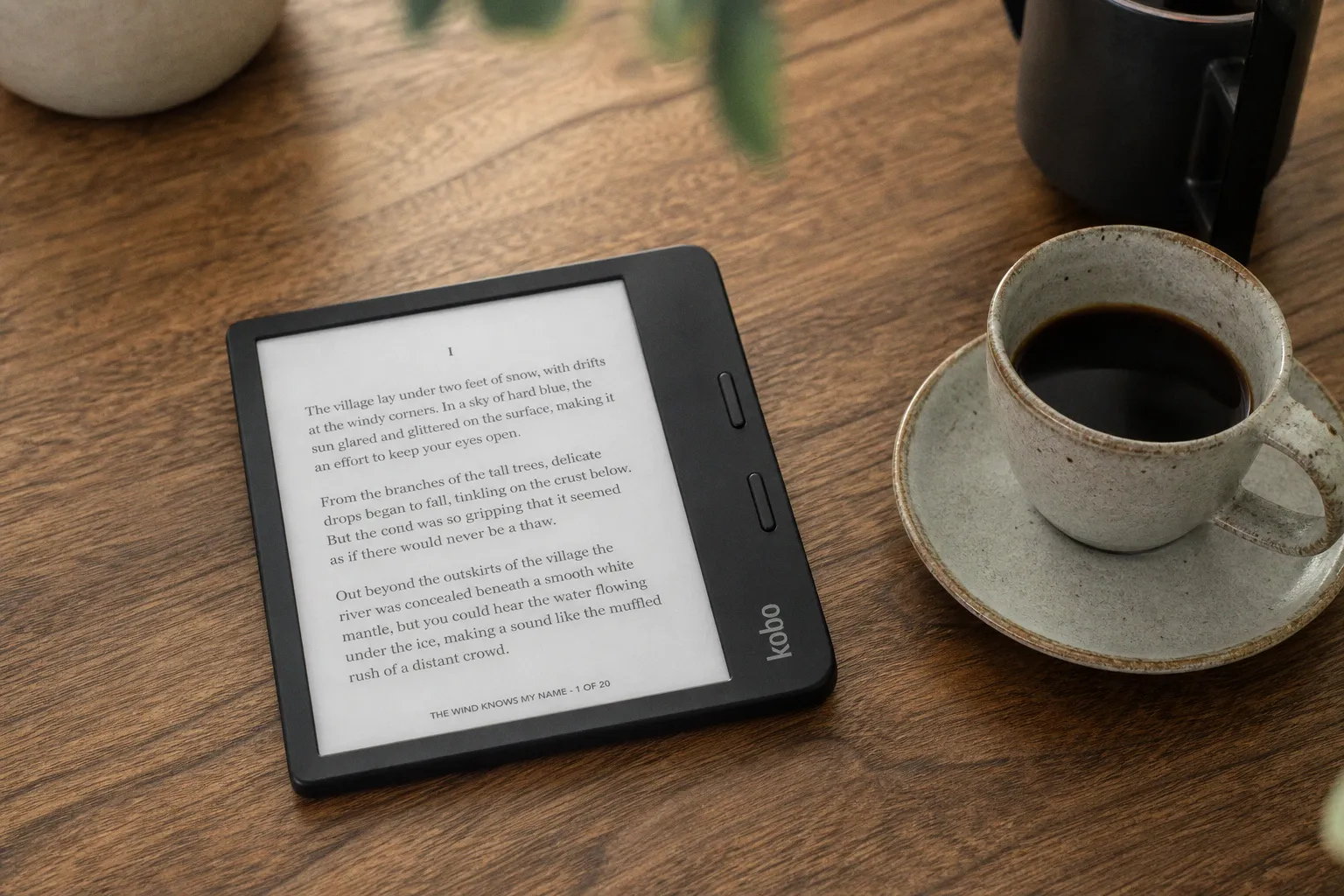
Deployed changes: rendering, selection, and cross-device sync
Three concrete adjustments now affect Web Reader rendering. Page-turn animation is selectable from Fade, Swipe, or the default blink; blink preserves the shortest interval between input and redraw, while Fade and Swipe introduce a transition interval that reduces ghosting artifacts on E Ink panels at the cost of perceived throughput. Text selection has been raised to a hard 600-character copy ceiling per selection — measured in typed characters — closing a previous truncation point for users transferring passages into annotation workflows. Product detail pages have also been reworked for faster load.
The larger structural shift is cross-surface sync. StoryGraph integration is now active across the Kobo app, Kobo Web Reader, and Kobo eReaders once accounts are linked, with reading activity, sessions, and progress flowing automatically. For readers operating Kobo alongside sideloaded e-papers, RSS-to-eBook pipelines, or third-party newspaper clients, this removes a manual logging layer that previously fragmented reading stats across apps.
Distribution-side, Kobo Plus has expanded to Poland, Romania, Czechia, the Philippines, Greece, and Luxembourg. Belgian subscribers gain Bancontact as a checkout method. Neither touches rendering or display parameters, but both widen the catalog reach of the all-you-can-read tier.
The late-2026 roadmap signal
Tamblyn's email does not enumerate devices, firmware versions, DPI targets, frontlight changes, or input-latency figures. The "read and write" framing is consistent with expanded annotation surfaces, stylus input layers, or platform-wide software rework, but no feature manifest has been published. Until hardware targets and software feature lists are disclosed, the announcement is directional only and should not anchor current device evaluation.
What to verify before switching
Readers comparing Kobo against alternative e-reading stacks should measure three variables on real hardware: Web Reader page-turn latency under the target browser and e-reader pairing, StoryGraph two-way sync fidelity across at least one full reading session, and product detail page load times under a throttled mobile connection. The late-2026 update is worth tracking but does not warrant purchase decisions today.