Bigme Hibreak Dual 2 Combines E-Ink and LCD Screens
Bigme has announced the Hibreak Dual 2, a dual-screen smartphone pairing a 6.13-inch color E-Ink display with a 5-inch LCD panel — a meaningful structural revision of the original Hibreak Dual, where…
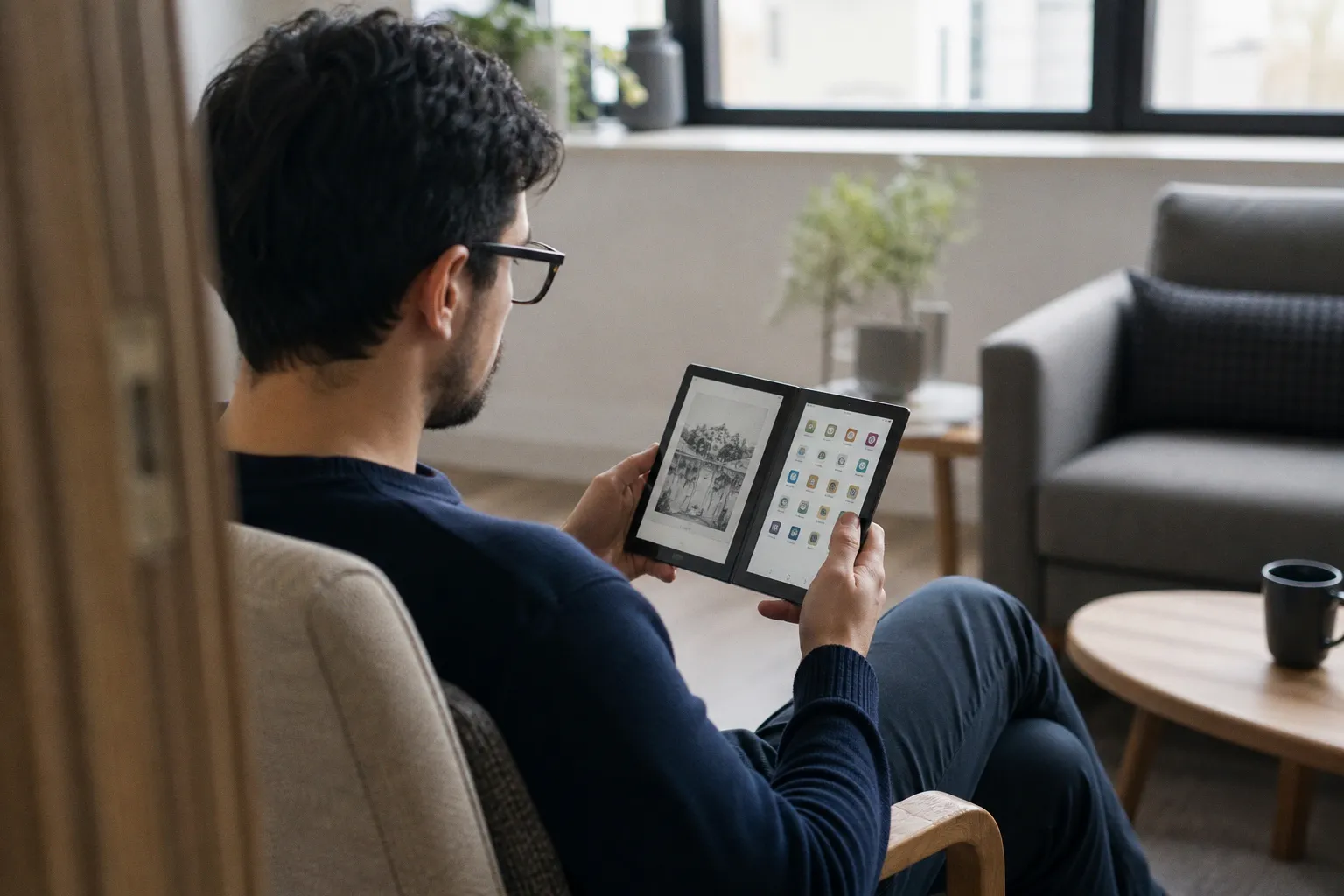
Bigme has announced the Hibreak Dual 2, a dual-screen smartphone pairing a 6.13-inch color E-Ink display with a 5-inch LCD panel — a meaningful structural revision of the original Hibreak Dual, where the secondary LCD was noticeably smaller and of limited utility. The crowdfunding campaign is live on Kickstarter, with an eventual retail listing on Amazon cited as plausible. For readers who track E-Ink hardware as a platform for periodical consumption, the key question is whether this device meaningfully narrows the gap between a dedicated e-reader and a daily-carry phone.
The Dual-Screen Shift: From Compromise to Near-Parity
The first-generation Hibreak Dual used a relatively small LCD alongside its E-Ink screen, forcing users into a binary choice: accept the limitations of a slow-refresh display for everything, or constantly switch to a cramped secondary panel for tasks requiring fluid interaction. The Dual 2 appears to address this directly. According to Notebookcheck's coverage, both screens are now "almost the same size and should be similarly practical to use." That's a significant design departure — it suggests the intent is not to relegate the LCD to a backup role but to treat both panels as co-primary interfaces. The E-Ink side retains color support, which matters for rendering magazine-style layouts, illustrated newspaper sections, and any PDF edition with embedded graphics.
Exact display specifications — pixel density, refresh rate for the E-Ink panel, frontlight configuration — have not been disclosed. Without DPI figures, frontlight uniformity data, or confirmed refresh behavior under partial updates, it's impossible to assess rendering quality for long-form newspaper PDFs or ePaper browser sessions. This is the single most important set of missing data points for anyone considering this device as a reading tool first.
Platform and Performance Notes
The MediaTek Dimensity 8300 is a known quantity: a capable mid-to-upper-range SoC, though described by sources as "somewhat older." For the specific workload of rendering PDF pages, paginated ePaper content, and running reading apps, it should provide adequate headroom. The confirmed presence of Android 16 is relevant — it determines which subscription apps, institutional access portals, and PDF annotation tools will be compatible at launch. Stylus input support, if implemented with adequate pressure sensitivity and low latency on the E-Ink side, could make on-device markup of newspaper PDFs and periodicals a practical workflow rather than a novelty.
What remains unconfirmed: RAM and storage configurations, battery capacity (critical for a device running an always-on E-Ink panel alongside an LCD), and whether the E-Ink display supports full or partial refresh for scrolling through dense multi-column PDF layouts. These details will determine whether the device functions as a credible substitute for carrying a separate e-reader.
Verification Window Before Committing
Kickstarter campaigns for niche E-Ink hardware carry a specific risk profile. Backers should wait for independent reviews that measure, at minimum: frontlight uniformity across both displays, ghosting behavior after 50+ page turns in a PDF reader, stylus latency on the E-Ink panel, and real-world battery life under mixed-screen usage. Bigme has shipped devices before — the original Hibreak was tested and reviewed — which mitigates the vaporware concern, but the Dual 2 represents a substantially revised hardware concept that warrants fresh empirical evaluation. An eventual Amazon listing would also provide the return-policy safety net that Kickstarter does not.